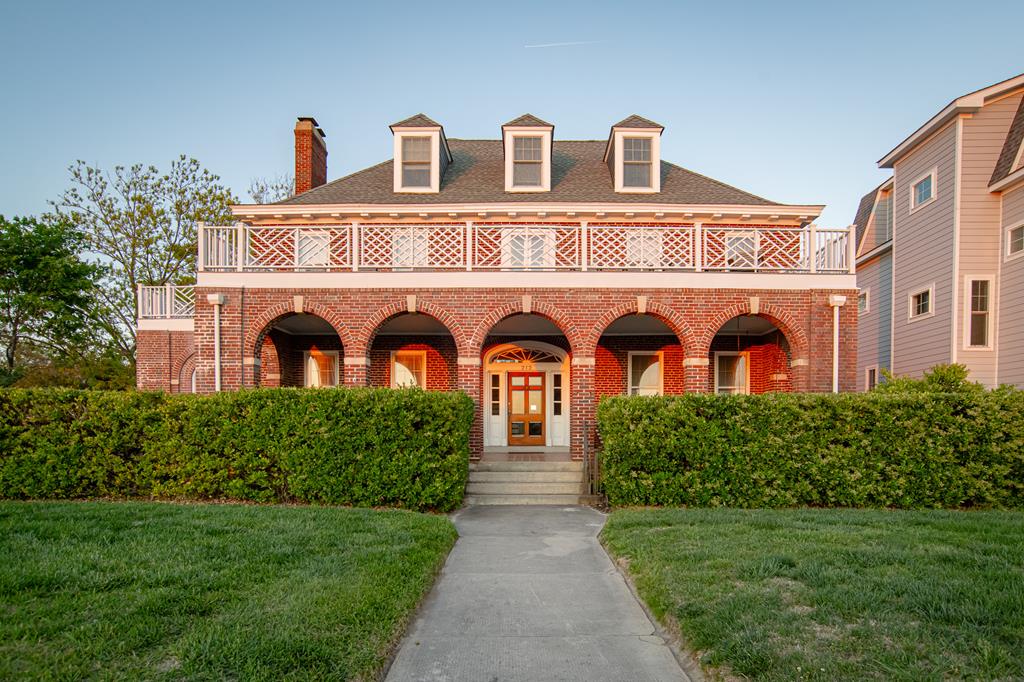
Part of what makes Cape Charles so special is also part of what makes it unique to buy into. The town’s walkable grid of Victorian cottages, wide front porches, and tree-lined avenues did not happen by accident, and it does not stay this way by accident either. Nearly the entire town sits inside a locally regulated Historic District, and if you are buying here, it is worth understanding what that means before you fall in love with a fixer-upper and start dreaming about changes.
The good news is that these rules are not something to fear. They are the reason your investment holds its charm and its value. Here is what every buyer should know about owning a home in the Cape Charles Historic District.
What Is the Cape Charles Historic District?
The Cape Charles Historic District encompasses nearly all of the town as it was originally laid out in 1883 and 1884, along with the Sea Cottage addition developed after 1909. It is a local overlay zone, adopted by Town Council in 2001, that regulates exterior modifications to existing buildings, the construction of new buildings, and demolitions within its boundaries.
If a home was built before 1965, it is generally considered a “contributing” structure, meaning it adds to the district’s historic character and carries the most careful review. The district is also listed on the National Register of Historic Places, with a period of significance running from the 1880s to 1964.
For an official overview, the Town maintains a helpful explainer on its Historic District Overlay page.
The Key Concept: The Certificate of Appropriateness (COA)
Here is the single most important thing for buyers to understand. A Certificate of Appropriateness, or COA, is required for essentially all exterior work on a property within the Historic District Overlay. That includes renovations, additions, new construction, fences, roofs, and demolitions.
A few things this does and does not cover:
- Interior work is not regulated. You can renovate your kitchen, redo bathrooms, or reconfigure interior spaces without historic review. The district is concerned with the exterior character visible to the public and the streetscape.
- Routine maintenance does not need a COA. Repairs that make no change to appearance, and repainting a non-masonry structure, are generally exempt.
- Everything else falls into “minor” or “major” work, both of which require a COA.
Minor Work vs. Major Work
Not every project goes through the same level of scrutiny. The Town sorts exterior projects into tiers:
- Routine Maintenance: No COA required. Think like-for-like repairs with no visual change.
- Minor Work: Requires a COA, but can often be approved administratively by Planning and Zoning staff if it clearly complies with the design guidelines. Faster, less involved.
- Major Work: Requires a COA reviewed by the Historic District Review Board (HDRB) at a public meeting. This covers substantial alterations, additions, new construction, and demolition.
The full classification of work is spelled out in the Cape Charles Historic District Overlay Design Guidelines, adopted in December 2022.
How the Review Process Works
If your project needs Board review, here is the general path:
- Optional pre-application meeting. These are not required but are strongly recommended. Planning and Zoning staff hold consultations to talk through a project before you formally apply. This step can save you real time and money.
- Submit a complete application packet. Incomplete packets do not advance to the agenda, so details matter. Applications reference specific sections of the design guidelines, covering things like roofs, porches, windows, doors, siding, and materials.
- Board meeting. The HDRB meets monthly (the third Tuesday at 5:00 p.m.). You or your representative should be present to answer questions.
- Decision. The Board issues or denies the COA, sometimes with conditions. You are then responsible for obtaining any separate building permits, which the COA does not replace.
You can find meeting schedules and application forms on the Town’s Historic District Review Board page.
What This Means in Practice: Porches, Windows, and Materials
The design guidelines are detailed, and they exist to keep new work compatible with the old. A few areas that commonly surprise buyers:
- Porches are a defining feature. Full-width, one-story front porches are the most common style in the district, and the guidelines treat them comprehensively. New construction is expected to include a substantial front porch spanning much of the facade, so if you are building or adding on, plan for it from the start.
- Windows, doors, and trim matter. Their size, placement, symmetry, and materials are all reviewed. Swapping in modern windows that change the look of the facade is not a given.
- Materials and details are scrutinized. From siding to spindles to roofing, the Board looks at whether replacements match the historic character. Alternative materials are sometimes approved, but not assumed.
- Paint colors on a non-masonry home are generally not regulated, which gives you more freedom than many buyers expect.
If you are weighing an older home against building or buying newer, our guide on new construction versus existing homes in Cape Charles walks through the tradeoffs in more depth.
Why This Is a Good Thing for Buyers
It is easy to read a list of rules and feel boxed in. But the Historic District is one of the biggest reasons Cape Charles looks and feels the way it does, and why homes here hold their appeal. The review process protects you from a neighbor putting up something wildly out of character next door. It keeps the streetscape cohesive. And it preserves exactly the qualities that likely drew you to town in the first place.
The buyers who do best here are the ones who go in informed. Know whether a property is contributing or non-contributing. Understand what you want to change before you close, and get a read on whether those changes are realistic. A good local agent and an early conversation with Planning and Zoning make all the difference.
To get a feel for how the historic district fits alongside the town’s other neighborhoods, our Cape Charles neighborhood guide is a great next read. You can also browse current historic district listings to see what is on the market right now.
Thinking About a Historic Home in Cape Charles?
Buying in the Historic District is absolutely worth it, but it helps to have someone in your corner who knows the process inside and out. Our team has walked countless buyers through exactly these questions, and we would love to help you find a home that fits both your vision and the rules of the road.
Reach out to Chesapeake Properties to start the conversation, and let’s find your place in Cape Charles.
This article is a general overview and not official guidance. Always confirm current requirements with the Town of Cape Charles Planning and Zoning Department before making a purchase or beginning a project.